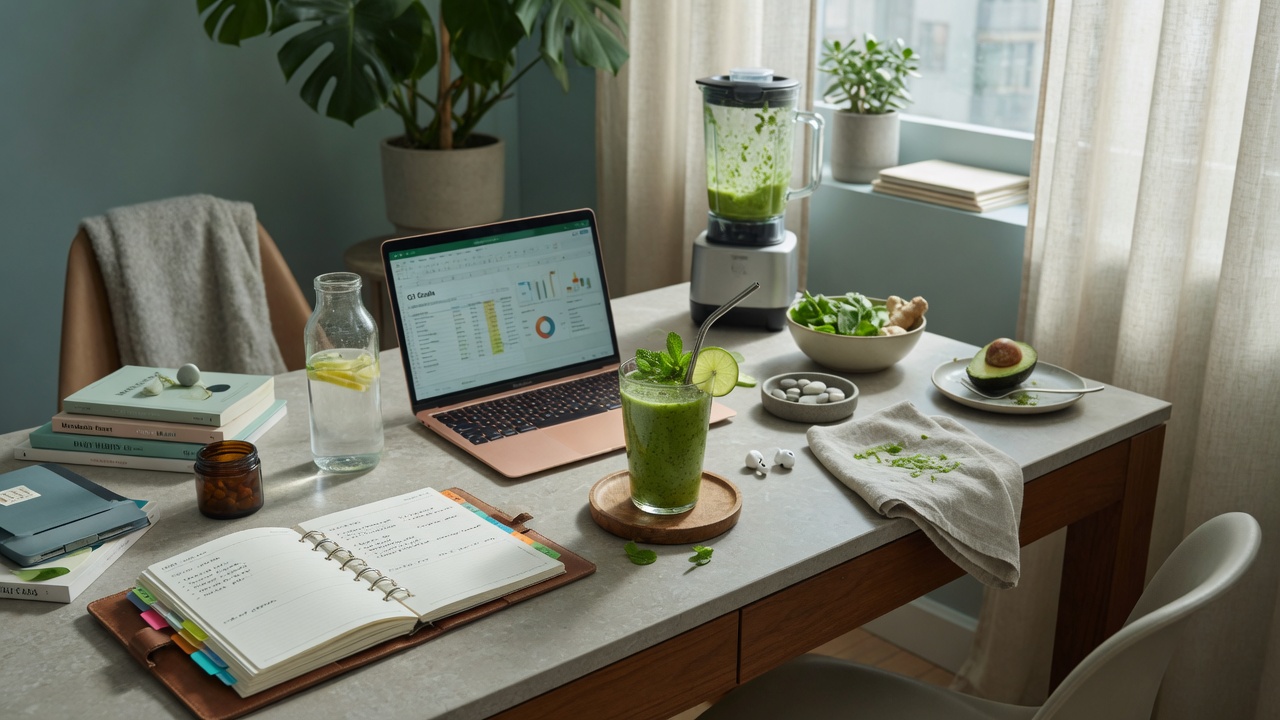
green detox smoothie
Green Detox Smoothie: 3 Recipes and What Detox Means
Three green detox smoothie recipes with fiber, calories, and protein from USDA data, and what the NIH says about detox drinks and weight loss.
Short answer
A green detox smoothie is a blended drink of leafy greens, fruit, and liquid, usually spinach or kale with apple, cucumber, lemon, and ginger. It is a good way to eat more vegetables and fiber. It does not remove toxins from your body, and the National Institutes of Health says there is no convincing research that detox diets help with weight management.
So this page treats "detox" as the name people search for, not as a promise. Below are three recipes with the fiber, calories, and protein added up from the USDA's public food database, followed by what the evidence says and who should be careful. The recipes were built from that data and were not made in a test kitchen, so adjust the liquid to the thickness you like.
What "detox" means here
The National Center for Complementary and Integrative Health (NCCIH), part of the NIH, reviewed detoxes and cleanses. Its summary:
- Only a small number of studies have looked at detox programs in people, and those studies were of low quality.
- A review found no compelling research to support detox diets for weight management.
- There have been no studies of long-term effects.
- The FDA and the FTC have taken action against several companies selling detox and cleansing products.
NCCIH also notes that very restrictive diets usually do not lead to lasting weight loss.
What a green smoothie does give you is ordinary and useful: vegetables, whole fruit, fiber, and water in a form that takes five minutes. That is the honest reason to make one.
Recipe 1: classic green (about 7 g fiber)
- 2 cups raw spinach
- 1 cup cucumber slices, peel on
- 1 medium apple, cored, skin left on
- 1 medium celery stalk
- 1 tablespoon lemon juice
- 1 teaspoon fresh grated ginger
- 1 cup cold water and a few ice cubes
Adds up to about: 7 g fiber, 135 calories, 3 g protein. This is a light drink to have with breakfast or as a snack. It is too low in calories and protein to stand in for a meal.
Recipe 2: creamy kale and avocado (about 14 g fiber)
- 1 cup raw kale, stems removed
- Half an avocado
- 1 medium pear, cored, skin left on
- 1 tablespoon lemon juice
- 1 cup unsweetened almond milk
Adds up to about: 14 g fiber, 310 calories, 4 g protein. The avocado and pear supply almost all of the fiber. Protein is low, so pair it with eggs, yogurt, or another protein food if it is your breakfast.
Recipe 3: pineapple, spinach, and yogurt (about 7 g fiber, 21 g protein)
- 2 cups raw spinach
- 1 cup fresh pineapple chunks
- 1 medium banana
- 1 single-serve container (170 g) plain nonfat Greek yogurt
- Half a cup of cold water
Adds up to about: 7 g fiber, 300 calories, 21 g protein. The yogurt makes this the one recipe of the three with enough protein to work as a small meal. It is also the sweetest, from the pineapple and banana.
What each green ingredient adds
From USDA FoodData Central:
| Ingredient | Amount | Fiber | Calories |
|---|---|---|---|
| Avocado | half | 6.7 g | 161 |
| Pear, with skin | 1 medium | 5.5 g | 101 |
| Apple, with skin | 1 medium | 4.4 g | 95 |
| Banana | 1 medium | 3.1 g | 105 |
| Pineapple, raw | 1 cup chunks | 2.3 g | 83 |
| Spinach, raw | 2 cups | 1.3 g | 14 |
| Kale, raw | 1 cup | 0.9 g | 7 |
| Celery | 1 medium stalk | 0.6 g | 6 |
| Cucumber, peel on | 1 cup slices | 0.5 g | 16 |
| Lemon juice | 1 tablespoon | under 0.1 g | 3 |
| Ginger, fresh | 1 teaspoon | under 0.1 g | 2 |
Blend it, do not juice it
Harvard's Nutrition Source explains that blending the whole fruit or vegetable, skin and pulp included, keeps the fiber. Juice from an extractor, and bottled juice even when labeled 100% fruit juice, lacks it. Cleveland Clinic says the same: what goes into the blender comes out in the glass, and juicing removes the pulp.
Harvard also says a smoothie should not replace eating fruit and vegetables whole. Think of a green smoothie as one more serving of produce, not as the only one.
Does a green detox smoothie help you lose weight?
Not by detoxing. NCCIH found no compelling research that detox diets help manage weight.
A green smoothie can still be a sensible part of eating less. The CDC says fiber moves slowly through the stomach and helps you feel fuller for longer, and MedlinePlus says fiber can help with weight control for that reason. Neither gives an amount of weight a person will lose, and this page does not either.
Two practical points follow from the numbers above:
- A light green smoothie is a snack. Recipe 1 has about 135 calories and 3 grams of protein. Using it in place of meals day after day would leave you short on protein and energy.
- A full one is a meal. Recipes 2 and 3 have about 300 calories. Drinking one on top of your usual breakfast adds to the day's total.
Why a days-long "cleanse" is a different thing
One green smoothie a day alongside normal meals is ordinary eating. Living on juices or thin smoothies for several days is not. NCCIH warns that fasting can cause headaches, fainting, weakness, and dehydration, and that juices which have not been pasteurized can make people sick. The FDA adds that children, older adults, pregnant women, and people with weakened immune systems are most at risk from untreated juice.
MedlinePlus says very low-calorie diets should only be used with a health care provider's help.
Wash the greens and keep it cold
The FDA says to rinse produce under running water before preparing it, without soap, and to cut away bruised areas. The CDC says to refrigerate perishable food, including cut fruit and dairy, within 2 hours. Drink a smoothie soon after blending or refrigerate it.
Who should not start with a green detox smoothie
Check with your doctor or dietitian first if any of these apply:
- A history of calcium oxalate kidney stones. Spinach is high in oxalate. NIDDK lists spinach among the foods a person who has had these stones may want to avoid, and NCCIH says people prone to kidney stones should limit high-oxalate foods. Recipes 1 and 3 use two cups of spinach.
- Warfarin. MedlinePlus says people taking warfarin may need to keep their intake of vitamin K foods, such as spinach and kale, steady from day to day. A new daily green smoothie changes that.
- Kidney disease. NIDDK says chronic kidney disease can make it harder for the body to clear potassium and that the right diet should be worked out with a professional.
- Diabetes. NCCIH advises people with diabetes to consult their health care providers before making major changes in eating habits. Fruit-heavy smoothies carry a lot of carbohydrate in one glass.
- Pregnancy. NIDDK says not to try to lose weight while pregnant, and the FDA's juice warning applies to unpasteurized ingredients.
- A current or past eating disorder. Cleanses and meal-skipping plans are not a safe place to start.
Common questions
What does a green detox smoothie do?
It adds vegetables, fruit, fiber, and water to your day. NCCIH found only a few low-quality studies of detox programs and no compelling evidence that they help with weight.
What is in a green detox smoothie?
Usually a leafy green (spinach or kale), a watery vegetable (cucumber or celery), a fruit for sweetness (apple, pear, pineapple, or banana), lemon, ginger, and water or unsweetened milk.
Is it OK to drink a green smoothie every day?
For most healthy adults, one a day with normal meals is ordinary eating. The people listed in the section above should check first, mainly because of the spinach and kale.
Spinach or kale?
Both are very low in calories. Per usual amount, USDA lists 2 cups of raw spinach at 14 calories and 1.3 grams of fiber, and 1 cup of raw kale at 7 calories and 0.9 grams. Spinach blends smoother and tastes milder. Spinach is the one to limit if you have had calcium oxalate kidney stones.
Sources
- NCCIH (NIH), "Detoxes and Cleanses: What You Need To Know": nccih.nih.gov
- USDA FoodData Central, SR Legacy data, for every nutrition figure on this page: fdc.nal.usda.gov
- Harvard T.H. Chan School of Public Health, The Nutrition Source, "Common Questions About Fruits and Vegetables": nutritionsource.hsph.harvard.edu
- Cleveland Clinic, "What You're Losing When You're Juicing": health.clevelandclinic.org
- CDC, "Fiber: The Carb That Helps You Manage Diabetes": cdc.gov
- MedlinePlus, "Fiber": medlineplus.gov
- MedlinePlus, "Diet for rapid weight loss": medlineplus.gov
- MedlinePlus, "Vitamin K": medlineplus.gov
- FDA, "What You Need to Know About Juice Safety": fda.gov
- FDA, "Selecting and Serving Produce Safely": fda.gov
- CDC, "Preventing Food Poisoning": cdc.gov
- NIDDK, "Eating, Diet, & Nutrition for Kidney Stones": niddk.nih.gov
- NIDDK, "Healthy Eating for Adults with Chronic Kidney Disease": niddk.nih.gov
- NIDDK, "Health Tips for Pregnant Women": niddk.nih.gov
Smoothie builder: Recipe 3: pineapple, spinach and yogurt
Change the amounts, add or remove ingredients, and the numbers update. Figures are from USDA food data. Your recipe stays on this page unless you choose to send us a note about the tool.
This smoothie adds up to about 302 calories, 21.2 g protein, 6.7 g fiber and 36.4 g sugar.
| Ingredient | Calories | Protein | Fiber | Sugar |
|---|---|---|---|---|
| Banana, 1 medium banana | 105 | 1.3 g | 3.1 g | 14.4 g |
| Pineapple, fresh, 1 cup of chunks | 83 | 0.9 g | 2.3 g | 16.3 g |
| Spinach, raw, 2 cup | 14 | 1.7 g | 1.3 g | 0.3 g |
| Greek yogurt, plain, nonfat, 1 170 g container | 100 | 17.3 g | 0 g | 5.5 g |
| Whole recipe | 302 | 21.2 g | 6.7 g | 36.4 g |
Missing an ingredient, a number looks wrong, or want to suggest your own recipe? Tell us
This is arithmetic on a recipe, not advice about what you should eat. Figures are averages from USDA food data for the measures shown; your produce, brands and scoops will differ. Each ingredient’s table and record number are listed on the tool’s own page. Soup figures use the ingredients as they go into the pot.
More in Tea, juice & bloating after 40
Full topic hub →- Best Tea for Water Weight: What Helps and What to SkipNo tea flushes out water weight. What the NHS and NIH say about green, dandelion, liquorice and senna teas, and what actually eases fluid build-up.
- Protein Smoothie Without Protein Powder: 4 Recipes, 28-36 GramsFour protein smoothies made with yogurt, milk, tofu, and seeds instead of powder, with a table of which foods add the most protein, from USDA data.
- Green Tea Anti Inflammatory After 40: A Busy-Adult Desk GuideGreen tea anti inflammatory basics for busy adults over 40—one lunch-break window, what to skip, who should wait, and when a structured smoothie plan fits.
- Best Tea for Weight Loss at Night After 40: A Calm, Practical GuideBest tea for weight loss at night after 40—sleep-safe picks, timing rules, and a simple desk-to-bed routine. Not a miracle; see who should wait.